Listen


 Facebook
 Nextdoor
 X
 WhatsApp
 Email
 Copy link

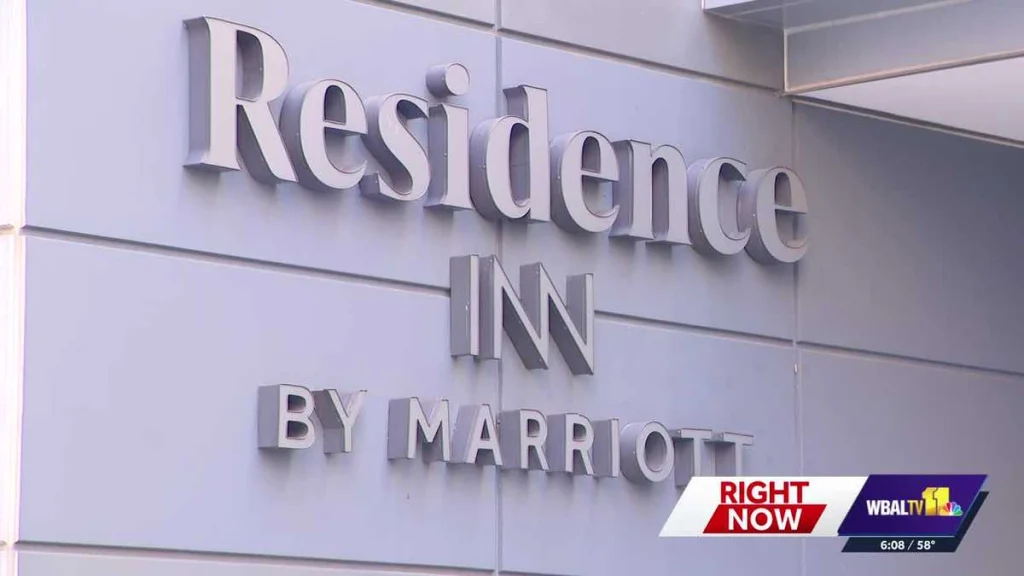
The Baltimore City Health Department is looking into two confirmed cases of Legionnaires’ disease linked to hotel guests. The guests stayed at a Residence Inn by Marriott near Johns Hopkins Hospital within the past five months.
The hotel sits at 800 N. Wolfe St. at The Johns Hopkins Medical Campus, according to Hoodline. Health officials said they are not certain the two guests caught the illness at the hotel. The guests had tested positive for the disease, WBAL-TV reported.
Hotel posts warning for Legionnaires’ disease
Hotel management posted a state health department notice at the entrance warning guests about the investigation, WBAL-TV reported. The front desk is also handing out information about the disease.
Management is working with a water consultant to check the building’s water system for Legionella bacteria, according to Hoodline. The hotel is putting in special filters in showers and sinks. It is also giving out bottled water and special drinks at the restaurant, WBAL-TV reported.
Guest Paul Dagati said he looked into the outbreak before deciding to check in anyway. “I think they’ve taken the necessary precautions. And speaking of sanitary, I mean, they’re advising not to shower, wash your hands with tap water, that sort of thing,” Dagati told WBAL-TV.
Not every guest felt that was enough. Desiree White Foster is a nurse who stayed at the hotel. She said she only learned about the Legionnaires’ disease investigation when she checked in.
“They definitely should have made a phone call,” Foster told WBAL-TV. “To give us a heads-up or give us other options to where we could stay.”
Who faces the highest risk from Legionnaires’ disease
Legionella bacteria grow in warm water such as lakes, rivers and streams, WBAL-TV reported. They can also take hold in pipes, hot water tanks, taps and shower heads.
The bacteria do not spread through human contact. Symptoms look like a serious case of pneumonia, according to WBAL-TV.
People over age 50 face the highest risk, the health department said. Those with cancer, lung or kidney disease face high risk. Smokers and people with weakened immune systems also face high risk, according to Hoodline.
Hotel guest Michelle Mouser said the illness especially worries her because of her husband’s health. “It really does affect people like my age or older 50. It affects my husband, that’s for sure, needing a transplant,” Mouser told WBAL-TV.
“But we were very careful because we’ve been through other transplants on dialysis, we know to be cautious with touching things,” Mouser said.
Symptoms of Legionnaires’ disease include fever, cough, shortness of breath, chills and body aches. They usually appear two to 14 days after exposure, according to the CDC, as cited by Hoodline.
What guests should do next
Guests who stayed at the hotel overnight since Sept. 13 are unlikely to develop the disease, the health department said. This applies to those with no symptoms whose last overnight stay was more than two weeks ago, WBAL-TV reported.
As many as 300 people are diagnosed with Legionnaires’ disease in Maryland every year. Health officials said this, according to WBAL-TV.
Anyone who stayed at the hotel and was later diagnosed with Legionnaires’ disease should call the Baltimore City Health Department. The number is 410-396-4436, WBAL-TV reported. Guests can also reach the Maryland Department of Health at 410-767-6700, according to Hoodline.
The investigation follows earlier Legionella concerns in Baltimore. Water testing at three Baltimore City courthouses found high levels of the bacteria, WBAL-TV reported.
In 2018, Legionnaires’ cases led to partial water restrictions at The Metropolitan of Baltimore apartment complex, according to Hoodline. Residents went nearly a month without showering or drinking from their faucets, according to Hoodline and the Baltimore Sun.
The water consultant’s check of the Residence Inn’s plumbing system is still going on, according to Hoodline. Officials have not shared findings beyond the safety advice given to guests.